Saturday, December 12, 2009

George Orwell: Politics & The English Language


Orwell's argument is that the English language is growing increasingly worse, portraying incompetence and no meaning.

Two cases of irony:

"This is a parody, but not a very gross one." -- Orwell is telling us to make our sentences clear, and easy, yet his description of his 'bad example of english' is not clear in itself. Gross, what does he mean by gross? Gross comes from the German word gro, which means large or big. And Orwell has been telling us not to take words from other countries, yet how can we do that, when our own language IS from other countries?

"A scrupulous writer, in every sentence that he writes, will ask himslef at least four questions...And he will probably ask himself two more: 1. Could I put it more shortly? 2. Have I said anything that is avoidably ugly?" -- Orwell is criticising peoples' writing, and is suggesting tips to ask yourself when creating a writing, yet, I wonder if he asked himself the same questions tha the is presenting us with. He says to ask yourself, "Could I put it more shortly?" and yet his own essay is extremely long!!!

Definitions:

Dying Metaphors - Worn-out metaphors which have lost all impressionable power.

Pretentious Diction - Foreign words used for their elegance, but in the process lose their original meaning.

Meaningless Words - Foreign words that are used with a vague and confusing meaning.

Ten Steps to Good writing:

#1 Use simple, every day words.

#2 Know what you want to say, before you start to write.

#3 Replace long, drawn out sentences, with short, to the point ones.

#4 Refrain form using foreign words to portray an english meaning.

#5 Read your work, to see if it makes sence to you.

#6 Make your work is clear, and easy to read.

#7 Use original thoughts.

#8 Always try to use the active, instead of the passive, when possible.

#9 Don't put in fluff - frilly nonsense that isn't important, and just used to take up space.

#10 Change your habits now, and start writing well.

Are We All The Same?


In poem 17 of Leaves of Grass, Whitman generalizes thoughts of men in "all ages and lands". He says that they are "not original with me". So, what does this mean? Is he saying that new ideas and thoughts are just old forgotten ones, that are presented as new? Is he saying that we all have the same thoughts and ideas with the stanza "If they are not yours as much as mine, they are nothing,"? Or is he simply saying that we all contribute to eachother's thoughts, and beliefs. Everyone is influenced by everyone else, until we all think and feel the same way? Maybe, he saying that if one person has a thought that does not coincide with another person's, no one will take notice, and therfore, the thought will be nothing, since it is not given any outside review. Once again, at the end of the poem, Whitman brings in grass. He says "this is the grass that grows wherever the land is, and the water is;/ This is the common air that bathes the globe./" Ithink he is making us all equal, all of our thoughts, ideas, and beings, with the fact that we all receive the same basics of the earth.

Leaves of Grass; Innocence of the Child


In poem 6 of Leaves of Grass, a child presents the question "What is Grass?" to Whitman. I think that this is portraying the innocence of a child. Then, Whitman realizes that he is just as unknowing as the child. Is this maybe creating the idea, that we are all children, trying to find answers to questions of nature? Then, Whitman proceeds by answering the question in multiple ways. "Or I guess...Or I guess...Or I guess" he writes, showing that humans try to guess the answer to questions, but never knowing what is the correct response.


After writing about what he guesses the grass is, he connects it to the graves of the dead. The grass grows from the deceased. Is he maybe connecting death with new life? Showing that there is a cycle, of never ending life and death, followed by new life? He finishes the poem with "All goes onward and outward-- nothing collapses; / And to die is different from what any one supposed, and luckier." In this stanza, he encorporates mimesis, by having a dash after outward, and then the sentence collapsing after the word collapse. This brings more attention and meaning to the end of the poem. I think that Whitman is trying to the cycle of death coming from life, and that death should not be feared.

Sunday, December 6, 2009

Felicite and Her Parrot, Loulou


"He was called Loulou. His body was green, his head blue, the tips of his wings were pink and his breast was golden" (chapter IV). How short, quick, and to the point. Flaubert does not add any frills or ruffles to the description of Loulou. He describes Loulou with simplicity, and does not go any further concerning his apearance. Yes, he goes more in depth with his personality, however he does so discreetly. I think that Flaubert is also describing Felicite with the parrot. How simple he is, how much character he has. However, the difference is that Felicite's character is swayed by the ideas of others, whereas toward the Parrot's, only impressions can be made.
The parrot Loulou had such a huge impact on Felicite's life, you would think that she would be overcome with sadness when he died, or at least longing for him to be alive again. However, she gets him stuffed. How odd is that? That is like getting your pet dog stuffed after he dies! Yet Felicite seems happy and content with her stuffed parrot, as much as she had been with her live one. "Every morning when she awoke, she saw him in the dim light of dawn and recalled bygone days and the smallest details of insignificant actions, without any sense of bitterness or grief" (chapter IV).

Felicite's adoration of the parrot goes so far, that she compares him to the Holy Ghost. This comparisson soon turns into a realization that the Holy Ghost and her parrot look quite the same. This develops into a belief that her parrot is the Holy Ghost, or at least one of the descendants. This shows how little Felicite's knowledge and understanding is for something that she takes so seriously, and is such a huge part of her life. She was taught wrong, and explained wrong what the Holy Ghost is. The Holy Ghost is, in fact, not a dove. It is the presence of God amongst people, to guide, comfort, and stay with people throughout their lives. She did not understand something that had made such an impact on her life. "She looked at him in despair and implored the Holy Ghost, and it was this way that she contracted the idolatrous habit of saying her prayers kneeling in front of the bird" (chapter IV).

Thursday, December 3, 2009

Gustave Flaubert; Style in His Writing


In Gustave Flaubert's novel, A Simple Soul, he incorporates personification in his frequent and elaborate descriptions. "The sleepy waves lapping the sand unfurled themselves along the shore that extended as far as the eye could see, but where the land began, it was limited by the downs which separated it from the "Swamp," a large meadow shaped like a hippodrome" (chapter 2). This sentence uses "sleepy", "lapping", and "unfurled", to describe a beach, clearly personifying it, while giving the text life and a more meaningful description.

Flaubert's descriptions are so clear, that he makes a mental picture for the reader, often using more than one of the five senses. "When the heat was too oppressive....dazzling sunlight....not a sound in the village..." (chapter 2).

Flaubert also has a habit of jumping from one topic quickly to another, for example, he was describing the beach, and then suddenly Felicite has found one of her sisters, and then Paul is going to a college.

His chapters also start with the last idea or event that took place in the end of the last chapter. This makes his thoughts run together, creating one long story, instead of a separate event in each section.

He gives his main character, Felicite, a personality that builds each chapter. He develops the character with each new event that takes place, and seems to bring her to life with his realistic and simple descriptions.

Monday, November 16, 2009

Hidden Meanings?

The Crying of Lot 49, written by Thomas Pynchon, ends with the words "...to await the crying of lot 49" (p.152). Why end his novel like this? I think that he is showing that, after searching during the entire book, Oedipa finally just waits for the answer to present itself to her. She is waiting to figure out how will "cry" for the lot 49. Why did Pynchon choose the number 49 though? I don't think it was just a random number. It must have some sort of symbol behind its innocent appearance. Was it the year that Tristero was created? Does it have to do with the fact that 4 is even, and 9 is odd?
And what is with the sentence "She heard a lock snap shut; the sound echoed a moment" (p.152). Were all of these people perhaps being locked in, to be killed or something? Or maybe it was just her, and all of these people were members of some sort of conspiracy, and she had gotten too close to figuring them out, and now she is either going to be killed, or offered a spot in their "priesthood" (p.152).
As the door is closed, the lobby windows and the sun are also shut out. Could this be hinting at a no escape kind of event? "The sun" might be symbolising enlightenment, concerning everything Oedipa was trying to find out in the first place.
What is the real meaning behind the ending of The Crying of Lot 49?

Auction items are called "lots"; a lot is "cried" when the auctioneer is taking bids on it; the stamps in question are "Lot 49". from Pynchon wiki, click here to go to the site

Saturday, November 14, 2009

Mucho changed

At the end of chapter 5, Oedipa is reunited with her husband. But, actually, she finds out that "the day she'd left him for San Narciso was the day she'd seen Mucho for the last time" (p118). She discovers that Hilarius had given him pills called LSD. He now is some complete different person, who thinks that he is an antenna sending his pattern out across a millino lives a night. The pills seem to have changed his entire being, and made him some sort of "calm" druggie, who believes the pills have changed his entire out look, and are good for him. But what were the pill's supposed to do? What was Hilarius trying to test when he gave them to Mucho? What was their purpose? And why would you test them on people, without knowing the results, and what would happen to the victim?

Monday, November 9, 2009

The Symbol

The Crying of Lot 49 seems to be targeting mystery stories. There is a symbol that Oedipa keeps seeing everywhere, it looks like this, and Oedipa refers to it as the WASTE symbol.
She first saw it in a bathroom stall, and then saw a young man drawing it on an envelope when she got lost at the Yoyodyne Stockholder's meeting, on a ring that belonged to an old man's grandfather, who cut it off of an indian's finger, and finally for a fourth time on a letter from the Pony Express issue of 1940.
So, yes. It is really creepy, intimidating and exciting. (cough cough) I searched the symbol on the internet when looking for a picture, and results came up calling it the "silent horn". I probably spoiled some big suprise for myself later on in the book, so, I decided not to research it further, and to just keep reading.
However, this symbol probably has to do with the whole hippie-government-rebellion thing that is going on. For example, the whole mail carrier ordeal, where they weren't using the government "monopoly" on mail service. The g
randfather who cut the ring with the symbol off of an Indian's finger was in the Pony Express(click for more information), in the gold rush days. So, I think this all has something to do with the mail.
The fourth time she sees the WASTE symbol, was on the 1940 issue of the Pony Express. At the same place, she saw an old German stamp with the workds Freimarke and Thurn und Taxis, which were the European mail service. "Decoratin each corner of the stamp...a horn with a single loop in it. Almost like the WASTE symbol" (p.77).
From all of these "clues" that Oedipa has been presented with, I think she is being led to discover some sort of governmental conspiracy, or some sort of rebellious tribe who has been going against the government.
She makes the connection whoever "they" were, their aim was to mute the Thurn of Taxis post horn.

Friday, November 6, 2009

Mail Call

As Oedipa and Metzger are sitting in a bar, having a modified-history class, a "fattish pale young man...started calling names and throwing envelopes into the crowd" (p.37). Whaaaaaaat? I had to read this paragraph three times to actually realize that they were talking about a real mail carrier, walking into a bar, and start throwing letters at people. It made me crack up; yet, what was the significance of this, other than just being plain funny, in a ridiculous sense?
Then when Oedipa writes down an address from the bathroom, and a symbol that was a "loop, triangle, and trapezoid" (p.38), I thought, okay, maybe Pynchon is targeting ridiculous scenarios? However, reading on, I found out that he was actually targeting rebels. Rebels who were against the government. So pretty much the people who go around doing...well, whatever they want I guess. The whole mail carrier ordeal was a way to rebel against the government "monopoly" on delivering mail. Great thing to rebel against, don't you think? It makes mail so much more, interesting and complicated.

Thursday, November 5, 2009

Chapter 2

Chapter 2 of The Crying of Lot 49 gave me something really complex to think about. However, it was not the kind of thinking I thought I would have to do in school.
It made me think about the values society has today. In the chapter, a married woman gets "laid" at a hotel by a nicely dressed man who later ends up having a pot-belly.
I have been brought up with the belief that marriage is a sacred thing, binding a woman and a man together, through their faith and their love for eachother, and that they honor eachother by staying loyal to one another. Also, that sex is a sign of love, reserved for married couples only.
I understand that many people do not have the same beliefs as I do, and don't get me wrong, I am not trying to be some sort of preaching-freak who goes around throwing holy water around and the word "evil!" Everybody, including myself, has the right to their own opinions and beliefs. And I am not trying to change, or insult, or bash anyone's beliefs. However, I think that my beliefs should also be respected.
This chapter really did make me think. This book is the second book this year that I have sort of cringed at, and winced at the contents. The first being Slaughterhouse Five, containing its vulgar language, and also, oddly enough, the senario where a married person commits adultery.
Our world is really becoming numb and immune to many things.
Yes, there have been movies and novels written about this sort of thing, and it is "real life" I guess, but I didn't think that I would have to read about it...for a school assignment.

Wednesday, November 4, 2009

The Crying of Lot 49; Identificaitons of Characters

Oedipa Maas - Recently named executrix of the estate of Pierce Inverarity, the novel seems to be written in third-person, limited to Oedipa, however I am not positive.

Wendell ("Mucho") Maas - Oedipa's husband; former used-car seller, seems to be a bit unstable...he gets easily upset.

Pierce Inverarity - Former lover of Oedipa; deceased.

Roseman - Family lawyer, wants to "run away" (p. 10) with Oedipa...he is married, and also tried to play footsie with Oedipa under the table.

Dr. Hilarius - called Oedipa at three in the morning, to discuss the pills she wasn't taking. Seems like a creepy scary scientist who does freaky tests on innocent people.

My thoughts so far on this book are:
1. It sounds like it was written by someone on drugs
2. It sounds like it is written about people on drugs
3. It sounds like it is going to go nowhere


Personification of a Virus...Not to Mention Everything Else


Chapter 13. The longest chapter in the history of man kind, extending from page 234 all the way until page 266. Only 32 pages you say? Well, it may not be physically the longest chapter ever, but content wise, it is. There are so many things you could talk about! How could you choose? Everything, you might say, talk about everything. Well, that might be a little difficult, as many of the letters just seeped into my eye sockets and went no further. However, because I myself am suffering from a bad cold, one thing did strike my attention, so, guess what...I will talk about that. I will try to do my best, too, because this is the last blog about The Selfish Gene. Thank Goodness!

So, the paragraph starts with "Consider" (p.246). Yes, we could consider many things. Why is the world round? The sky blue? Why cows say 'moo'? Etcetera, etcetera. Yet, like most things, the sentence goes on, slowly developing itself until the paragraph ends with "viruses" (p.246). So, now, we are considering viruses. Those nasty little things that give us symptoms that are not fun at all. Usually involving tissues, runny noses, head aches, and sneezing. "Annoying byproducts" (p.246), right? However, Dawkins states that they are "engineered [the symptoms] by the virus to help it to travel from one host to another" (p.246). Well this is just great. I knew all about germs and how you should wash your hands, but now all of a sudden viruses are purposefully engineering new ways to get around, and make us miserable! Great! Just peachy.
Then I realized, Dawkins does this alot. He personifies things, things that are incredibly weird to personify. Viruses, and even specific genes. His famous "selfish" gene as well. He makes it sound like it has a mind of its own, when, in fact, it has no "mind" at all. What is up with this?
"...nature teems with animals and plants..." (p.253)
"Natural selection favours those genes that manipulate the world to ensure their own propagation" (p.253).
What is up with this? Nature is not an actual organism, it can't be teeming up with anything! Natural selection cannot favour certain genes. And genes, how are they supposed to manipulate the world?

I think Dawkins is trying to explain something that he himself thinks has become intellegent, seeking survival, changing throughout its life time, and then passing on those changes to its offspring. But that cannot be right at all. You cannot change your genes. Even if you acquired characteristics during your lifetime, like muscles for example, you wouldn't pass that on to your offspring, they would have to build up their own muscles. Like wise, genes cannot grow "intellegent" and figure out how to survive, and then pass those genes to survive on to their replicated offspring, it just doesn't work. Sure, maybe they could "tell" them about it, but honestly, genes are doing any "telling" at all!

I finish this book with a jumbled and confused head. What is he trying to prove any way?

The last sentence answers this question.

"The only kind of entity that has to exist in order for life to arise, anywhere in the universe, is the immortal replicator" (p.266).

...alrighty, now what is that supposed to mean?

Friday, October 23, 2009

Prima Facie

At first glance, the words in Macbeth seem to be a jumble of poems, put into a blender, swished around, with rhyming words at the ends. However, when we look closer, we can make sense of what he is saying, and then understand the play, meanwhile enjoying the way things are written by Shakespeare. According to Dawkins, "Langauage seems to 'evolve' by non-genetic means, and at a rate which is orders of magnitude faster than genetic evolution" (p 189).

We can nod our heads, and agree with this, because already, we speak differently than our parents did when they were kids. The language gap is even greater with our grandparents, and greatgrandparents. In the 70s, they would say 'groovy', whereas now we would say 'cool'. Somewhere in between there, people would refer to it as 'neat'. Likewise, at one point, people actually did talk the way Shakespeare writes. Of course, not in rhyme, because that would just annoy people, having to rhyme all the time; however, they used vocabulary like beguile and compunctious. Although we wouldn't say things like "I beguiled my parents into letting me go out this weekend", or "I was siezed by compunction when I came home later that night", we can still figure out what the point of the sentence is.

However, if we were to look at language that was from even further back, we would not even be able to get the basic concept.
Could it be, that hundreds of years from now, or even just twenty, people will look at the way we speak today, and laugh about it? And wonder how in the world we ever could speak like that in a day to day situation?

"You Scratch My Back, I'll Ride On Yours"

The above is the title of chapter 10. As the title foreshadows, the chapter covers the fact that somethings don't know the golden rule "Do to others as you would have them do to you". They simply accept the, as Richard Dawkins would call it, altruism of others, and do not return the kind gesture when the other needs them. Although Dawkins used birds to explain this, you could also use it to explain the actions of the new United States and France.
During the colonies revolution, the French supported them with naval help, soldiers, and supplies. However, after the British were defeated, and the United States established with their own Constitution, things kind of just were put on the back burner concerning their relationship with France. When France began their own (bloody) revolution, they needed help. They got themselves into a mess with Britain, and started a war. However, the United States was very fragile, and needed Britain as a friend, and they were also having a nice time trading with them. So, when the French asked the United States to help them fight the British (as they had helped them do a while ago) the president, George Washington, decided to just stay neutral, and not fight the British for the French.

This could be seen as similar to the bird situation in chapter 10. However, the United States did help the French concerning supplies, like wise they helped the British in the same way, yet this was more of a 'sellfish' act, because they needed the trade, and profit.
I wonder how Dawkins would explain this whole North American - French - British ordeal. He would probably say they were all selfish, and were focusing on their own needs when helping the others. He would probably write a really long and (cough,cough) "interesting" chapter and name it "You Fight My War, I'll Make A Profit From Yours".
The Website below is an article of the Neutrality Proclamation that George Washington presented.

Animal Attraction vs. Human Attraction

Animals:
Males=Attractive/Flashy Females=Blend in/ Drabby


Humans:
Males=Less Flashy Females=Flashy

Blackmailing-Baby Birds

A certain idea in chapter 8 left me quite puzzled. The author was bringing forth the idea that birds 'blackmail' their parents. They scream loudly so as the parent is left with the choice of giving the bird more food, or letting it scream until a predator comes. Now this doesn't really seem to make sense to me. How could one bird decide one day, okay, I am going to scream really loudly until you give me food, or else I will just keep screaming until a fox comes and eats me and you.
Baby Bird: SCREAM SCREAM SCREAM!
Mommy Bird: Here is some food.
Baby Bird: SCREAM SCREAM SCREAM!
Mommy Bird: I already gave you food.
Baby Bird: SCREAM SCREAM SCREAM!
Mommy Bird: Okay here is some more food.
How do you prove that the baby bird is 'blackmailing' the mommy bird? Could he not just be hungry, and want more food? I don't think that birds can go through the process of thinking, 'if I scream, I will attract predators, so if I keep screaming, my mommy will want to shut me up so no predators find us, so if I just keep screaming, she will give me more and more food.'
Um...I don't know, but that just doesn't really seem logical to me that a baby bird would know about predators even before he is out of the nest, and that he would try to threaten his food-provider, who could just up and leave if a predator came.

Parental Care - Kin Selection


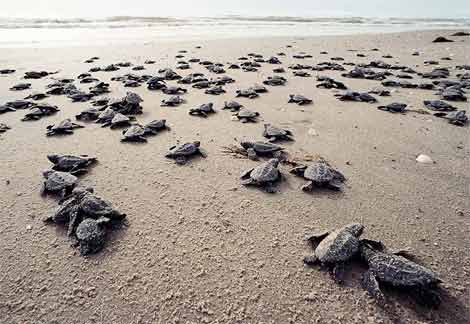
How would The Selfish Gene go about explaining the fact that some animal mothers eat their newborn babies? The ones that are weak, and probably won't survive anyway? Would this still be some form of altruism towards their kin, they want them to suffer less, so they eat them, instead of having them starve to death, or by some other means? What about Sea Turtles, who crawl up to shore, lay their eggs, and then leave, leaving their babies to figure out how to get to the shore themselves? I don't think that all parents necessarily care for their offspring in the way that Richard Dawkins explains in The Selfish Gene.

Dove or Hawk?

In chapter 5 of The Selfish Gene, they characterize fighting strategies as either hawk or dove. "Hawks always fight as hard and as unrestrainedly as they can, retreating only when seriously injured" (p 70). Doves however "merely threaten in a dignified conventional way, never hurting anybody" (p 70). I thought about this for a while. Are humans hawks or doves? Do many of us ever really fight with someone else until injury or death? Maybe a few, however, most of us just use threats, and never really live up to them. This made me think of Macbeth. He must have been a hawk, because he killed so many people, right? However, I think he might not be completely hawk, but also dove as well. In Act 1 scene 7, he is questioning himself whether or not to actually follow through with the murder of King Duncan. He says, "He's here in double trus: First, as I am his kinsman and his subject, Strong both agains the deed; then, as his host, Who should against his murderer shut the door, Not bear the knife myself. Besides, this Duncan Hath brone his faculties so meek, hath been So clear in his great office, that his virtues Will plead like angels, trumpet-tongued, against The deep damnation of his taking off" (Act 1. sc. 7 lines 12-20). His train of thought is so clear and ringing with truth, that if left to himself, he probably would not have commited the murder at all. But of course that wouldn't really be a good story, Macbeth is prophesized to be King, however after thinking things through, decides he better not kill anyone. No, it wouldn't have been a very big hit. So, instead, Shakespeare brings in Lady Macbeth, who is hawk through and through. She pushes Macbeth to kill Duncan, thus fulfilling the prophesy. However, what would you then call someone who is half hawk and half dove? A Hawve? Because so many things in this world are not completely one or the other, I think it would have been smart to address this point. If a being sometimes backs down, however sometimes fights till the death, what would he be called, according to The Selfish Gene?

Wednesday, October 21, 2009

Trick to get a Treat

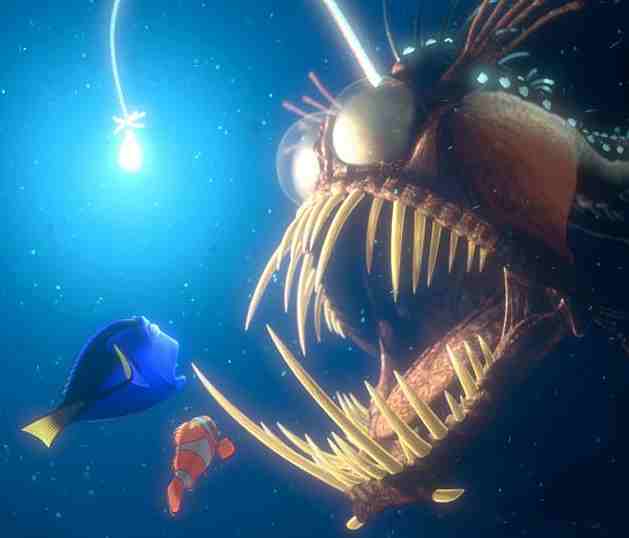
Okay, so let me get this straight, animals lie? Are you serious? You said "the angler is telling a lie, exploiting the little fish's tendency to approach wriggling worm-like objects" (64). I think you are stepping into gray territory when you use the word "lie" for this method of obtaining food. Personally, I think he is just tricking. The poor guy is just trying to get some food, trying to survive, and you go and throw the weight of a mortal sin on his shoulders. I think he just heard about Halloween, but got confused, and instead of Trick or Treat, he heard Trick for a Treat. Therefore, it really isn't that bad if he does trick to get his food. After all, he is just a Survival Machine, trying to be on the list for Natural Selection. So, I think you owe Mr. Angler an apology.
(Plus, he is a famous movie star in Finding Nemo, using his amazing techniques, he helps Marlin find the mask!)

Survival Machines

If we were really Survival Machines as the book is arguing we are, then why would we even bother to reproduce? It doesn't affect our certain individual directly, does it? And if the book would then argue, 'it would matter if we were talking about a certain group of organisms trying to survive,' then why would it matter if the offspring were to receive 50% or 100% of the parent's genes?